How often to change aquarium water: a starting point
| Tank | Typical starting point | Why |
|---|---|---|
| Established, lightly stocked, planted | 10 to 20% weekly or every other week | Plants take up some nitrate |
| Established, average stocking | 20 to 30% weekly | Keeps nitrate from building |
| Heavily stocked or large messy fish (goldfish, cichlids) | 30% or more weekly, sometimes twice a week | More waste per litre of water |
| Small tank or bowl | Smaller, more frequent changes | Levels change fast in small volumes |
| Tank still cycling | Only when ammonia or nitrite run too high | Large changes can slow the cycle |
Treat the table as a place to start. Two tanks of the same size can need very different schedules. A regular routine at a steady size is easier on fish than long gaps followed by one huge change.

Tankleaf sets water changes as a repeating task, and its charts mark each water change day so you can see nitrate drop after every change. Get it on Google Play
What a water change actually does
The filter turns ammonia into nitrate, but nothing in a typical freshwater filter removes the nitrate. It builds up until water is taken out. Water changes also replace minerals that are used up over time, which helps keep pH and hardness (KH and GH) steady, and they dilute other dissolved waste that tests do not measure.
Topping up water that has evaporated is not a water change. Evaporation removes pure water and leaves the waste and minerals behind, so the concentration goes up.
How much water to change: the nitrate math
A worked example shows why the size of the change matters more than people expect. Say nitrate rises by 10 ppm a week in your tank and the tap water has none.
| Weekly change | Nitrate right after the change | Nitrate just before the next change |
|---|---|---|
| 10% | 90 ppm | 100 ppm |
| 25% | 30 ppm | 40 ppm |
| 50% | 10 ppm | 20 ppm |
These are the levels the tank settles at after several weeks. With a 25% change, the level after each change (x) satisfies 0.75 × (x + 10) = x, which gives x = 30. The same calculation with 10% gives 90, and with 50% gives 10.
The numbers are an example. Your weekly rise will be different, and tap water often contains some nitrate, which sets a floor you cannot change below. In the United States your water supplier publishes an annual Consumer Confidence Report with its nitrate results; in England and Wales the Drinking Water Inspectorate explains how to get your supplier's water quality data.
Things that change the schedule
- Stocking. More fish, or larger fish, means more ammonia and so more nitrate.
- Feeding. Uneaten food breaks down into the same waste. Feeding less is often the easiest way to slow nitrate.
- Plants. Growing plants use nitrate. Melting or dying plants add to the load.
- Tank volume. The same fish in a smaller tank push the numbers up faster.
- Species. Some fish and many shrimp and snails are more sensitive to changes in water chemistry. Check the needs of what you keep with the breeder, the shop or a species guide.
- Filter type. A larger filter handles ammonia, but it does not remove nitrate.
Finding your own tank's schedule
- Pick a target for nitrate based on what you keep. Species guides and your shop can suggest a range.
- Test nitrate just before each water change for three or four weeks. Note the date and the size of the change.
- If nitrate keeps climbing week after week, change more water or change more often.
- If it stays well below your target, you can try a slightly smaller change and keep testing.
- Recheck after anything changes: new fish, more feeding, plants removed, a new filter.
A chart of nitrate over a few months makes the pattern obvious: a saw-tooth that drops after every change and climbs again. If the tops of the teeth are rising, the schedule is not keeping up.
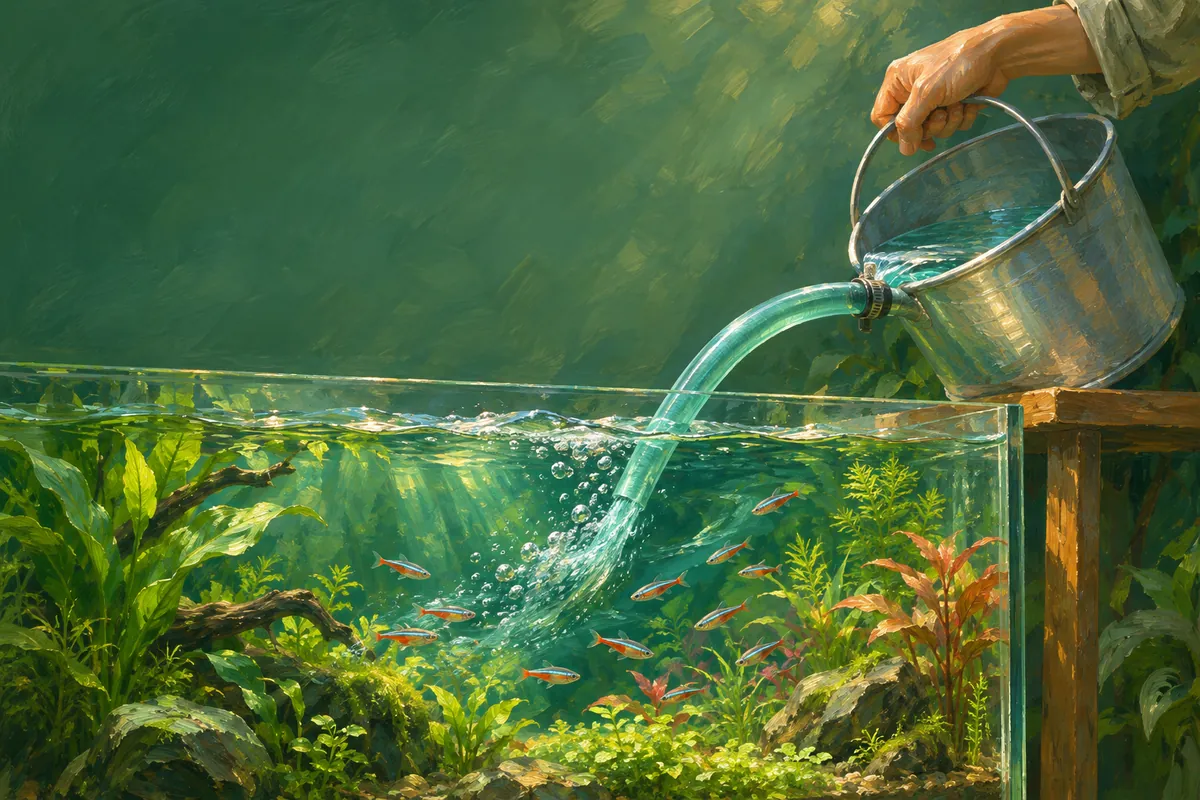
Doing a partial water change
- Switch off the heater, and the filter if the water level will drop below its intake.
- Siphon water out with a gravel cleaner, lifting debris from the substrate as you go.
- Treat the new water with a dechlorinator. Many suppliers use chloramine rather than chlorine, which does not evaporate when water stands; the US EPA explains the difference. Use a conditioner that states it handles chloramine.
- Match the temperature of the new water to the tank as closely as you can.
- Refill slowly, then switch the equipment back on.
Use a bucket kept only for the aquarium, so soap and household cleaners stay away from the tank.
See whether your schedule keeps up
Log nitrate before each change in Tankleaf and the chart shows the saw-tooth pattern with your target range shaded, so you can tell whether to change more or less.
Get it on Google PlayiPhone version coming soon
More guides
- How to Cycle a Fish Tank: Fishless Cycling Step by StepHow to cycle a fish tank before adding fish: the nitrogen cycle, a fishless method step by step, what ammonia, nitrite and nitrate tests show, and when it is done.
- How to Test Aquarium Water: Kits, Steps and What to TestHow to test aquarium water: test strips vs liquid kits, step-by-step testing for ammonia, nitrite, nitrate and pH, how often to test, and how to read results over time.
- High Nitrates in Aquarium Water: Causes and What to DoHigh nitrates in your aquarium? Check the reading, find the cause (feeding, stocking, tap water, filter), bring it down gradually with water changes, and keep it there.
- Aquarium Maintenance Schedule: Daily, Weekly and Monthly ChecklistAn aquarium maintenance schedule you can copy: daily checks, weekly water changes and tests, monthly filter care, and occasional jobs, with tips on keeping it going.
Published by Zoranta, the developer of Tankleaf.