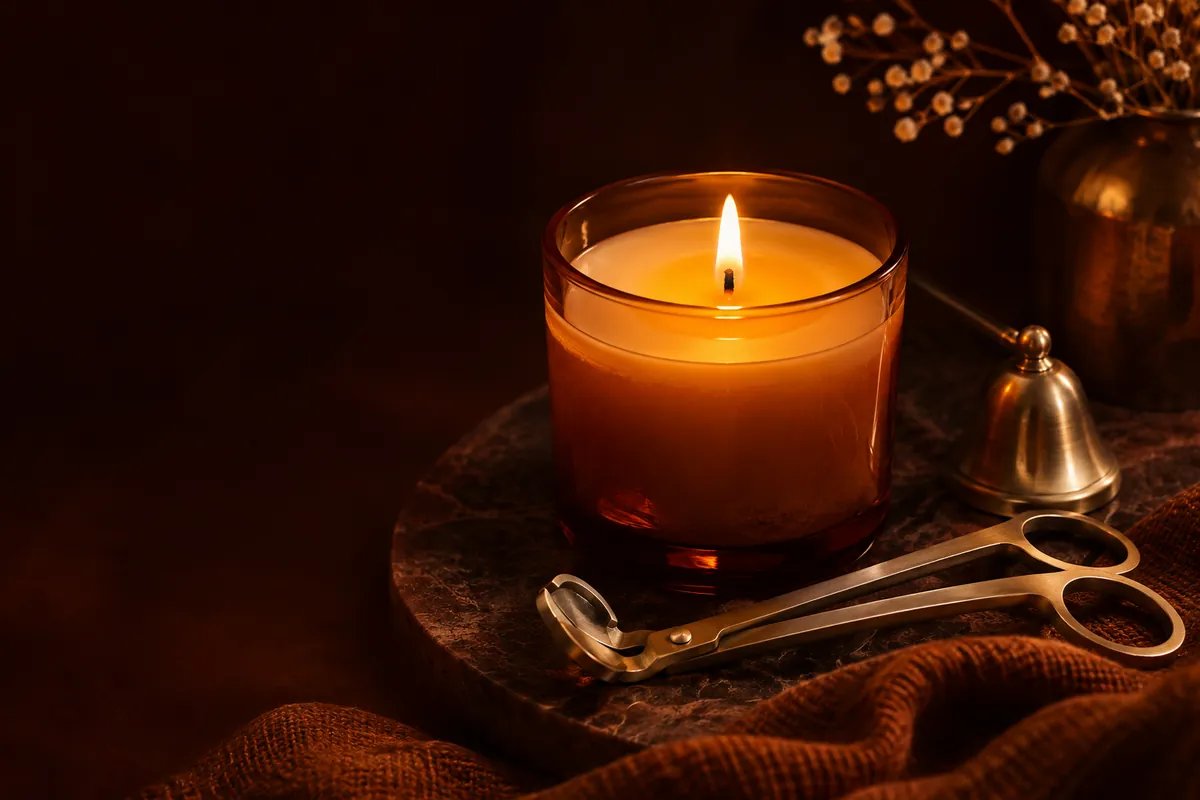
Candle burn time per oz: the basic formula
The candle burning time formula most makers use is:
- Burn time (hours) = wax weight (oz) × hours per ounce
- Hours per ounce = hours burned ÷ ounces of wax used up
The wax weight is usually the net weight on the label, which counts the wax and fragrance but not the jar. The hours per ounce depend on the candle, which is why the same 8 oz size can be sold with very different burn time claims.
| Net wax weight (example) | At 5 hours per oz | At 7 hours per oz | At 9 hours per oz |
|---|---|---|---|
| 4 oz | 20 hours | 28 hours | 36 hours |
| 8 oz | 40 hours | 56 hours | 72 hours |
| 14 oz | 70 hours | 98 hours | 126 hours |
Treat this candle burn time chart as a rough guide for comparing sizes, not as a promise for any one candle. If the label states a burn time, start from that.
In Candle Shelf you note how long each burn lasted and how the throw was, and when a jar is finished the count goes down and it moves to Finished. Get it on Google Play
How to measure the burn time of your own candle
A kitchen scale that reads to a tenth of an ounce or to the gram is enough.
- Weigh the whole candle, jar and all, before you light it. Write the number down.
- Burn it for one normal session, letting the melt pool reach the edge of the jar.
- Blow it out, let it cool and harden completely, then weigh it again.
- Divide the hours burned by the weight lost. That is your hours per ounce.
- Multiply by the net wax weight on the label to estimate the full burn time.
Worked example
| Step | Figure |
|---|---|
| Net wax weight on the label | 8 oz |
| Weight before burning | 15.2 oz |
| Burned for | 3 hours |
| Weight after cooling | 14.7 oz |
| Wax used | 15.2 − 14.7 = 0.5 oz |
| Hours per ounce | 3 ÷ 0.5 = 6 |
| Estimated burn time | 8 × 6 = 48 hours |
One session is a small sample. Weighing over two or three burns and adding the hours and ounces together gives a steadier number. You will also not burn the very last bit of wax, because the National Candle Association suggests stopping when about half an inch remains, so the usable hours come out a little lower than the estimate.
Cost per hour of burning
Once you know the burn time, you can compare candles by what an hour of burning costs rather than by the price tag.
| Example | Candle A | Candle B |
|---|---|---|
| Price | $28.00 | $18.00 |
| Estimated burn time | 48 hours | 25 hours |
| Cost per hour | 28 ÷ 48 = about $0.58 | 18 ÷ 25 = $0.72 |
In this example the more expensive candle costs less per hour. The figures are made up for illustration; real burn times vary even between jars of the same scent.
How long do candles last while burning? What changes it
- Waxes melt at different temperatures, and blends burn differently from a single wax.
- A bigger wick or a three-wick candle melts wax faster and uses it up in fewer hours.
- A long, untrimmed wick gives a taller flame that burns faster and can smoke. Trimming before each lighting helps keep the flame steady.
- Moving air from a fan or vent makes the flame flicker and burn unevenly.
- Very short burns can lead to tunneling, which leaves wax unburned at the sides. Very long burns can overheat the jar and the wick. Many labels give a maximum burn time per session; follow it.
If a candle tunnels, part of the wax never burns at all, and the real burn time drops a lot. Our guide on candle tunneling explains how to prevent it and how to fix it.
Keeping a burn log
Writing down each session is the easiest way to learn how your candles actually perform. A note per burn is enough:
| Date | Candle | Minutes burned | Melt pool reached edge? | Scent throw |
|---|---|---|---|---|
| Example | Fir and cedar, 8 oz | 180 | Yes | Strong |
| Example | Vanilla bean, 4 oz | 90 | No | Light |
After a few weeks, the log shows which candles fill the room, which tunnel, and which run out faster than their label suggests. That is useful when you decide what to buy again.
Log your burns without a notebook
Candle Shelf keeps a burn log for every candle in your collection, so you can see how each one performed before you buy it again.
Get it on Google PlayiPhone version coming soon
More guides
- Candle Tunneling: Why It Happens and How to Fix ItWhy a candle burns a hole down the middle, how to fix tunneling with foil or by evening out the wax, and how a long enough first burn helps prevent it.
- Candle Scent Throw: Hot Throw vs Cold Throw and Weak CandlesWhat candle scent throw means, the difference between hot throw and cold throw, why a candle is not throwing scent, and how to judge throw fairly at home.
- How to Store Candles So They Keep Their ScentWhere and how to store candles long term: cool, dark and dry, lids on, upright. Whether candles expire, signs a candle has aged, and how to rotate your stock.
- How to Organize Candles: Sorting, Storage and a Collection ListHow to organize candles at home: clear out, sort by scent family or season, split display from backstock, keep a simple inventory list and stop buying duplicates.
Published by Zoranta, the developer of Candle Shelf.