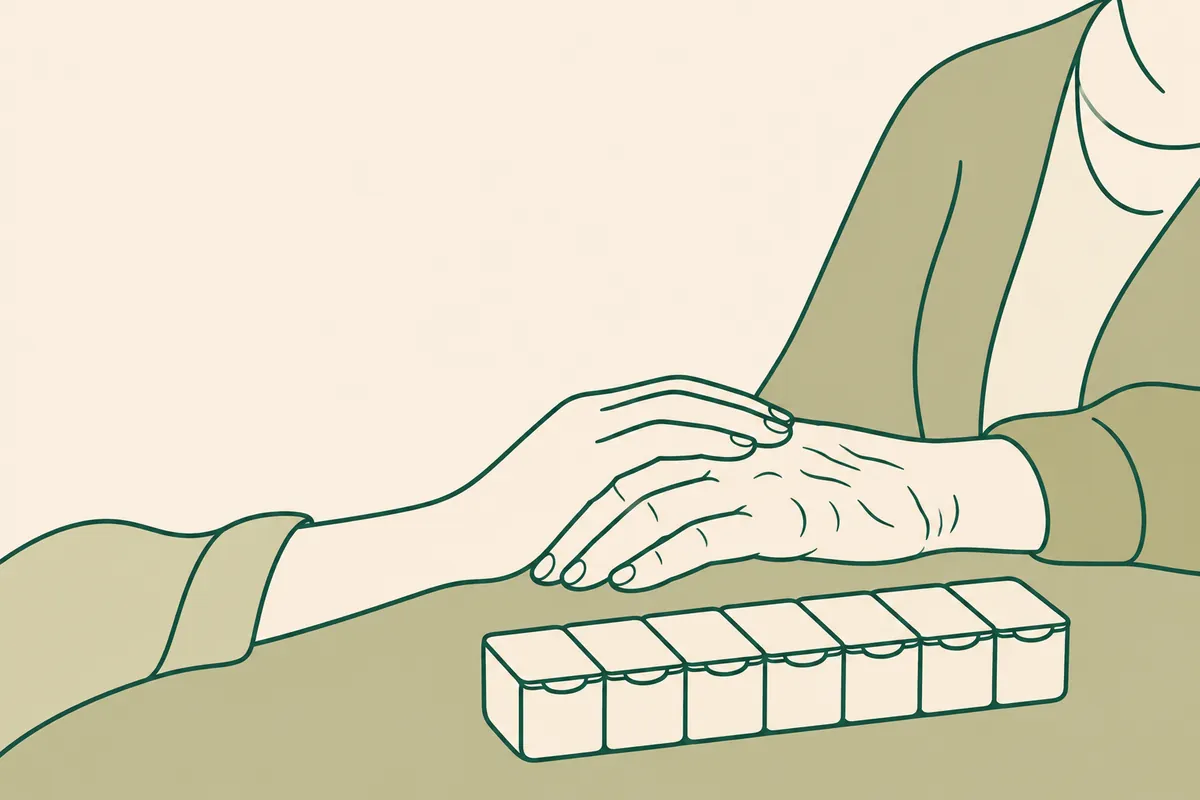
How to use a weekly pill organizer, step by step
- Pick a fixed time each week to fill it, for example Sunday evening, somewhere quiet with good light and a clear table.
- Lay out your medicine packs and your current medication list. If you do not have a list, make one first.
- Take one medicine and put it into every compartment where it belongs, Monday to Sunday, before you open the next pack.
- Put the pack away once it is done, so you cannot pick it up twice.
- When every medicine is in, check each day against your list: count the tablets in each compartment.
- Close every lid and check that the days and times face the right way.
- Write the date you filled it on your list or calendar.
Working one medicine at a time across the week is slower than filling one day at a time, but it is easier to see when a tablet is missing or doubled. If two tablets look alike, fill them on different passes.
Nondacho groups today's medicines into morning, midday, evening and bedtime, the same way as a four-compartment box, and keeps the time you tap Taken for each one. Get it on Google Play
Choosing the layout: once, twice or four times a day
Organizers come with one, two, three or four compartments per day. Choose the one that matches the times on your labels, not the one that looks neatest.
| Your medicines are taken | Layout that fits | Watch out for |
|---|---|---|
| Once a day | 7 compartments, one per day | Easy to fill, but a second daily medicine later means changing boxes |
| Morning and evening | Pill organizer 2 times a day (AM/PM) | Check the AM and PM rows are not swapped when you pick it up |
| Up to four times | Pill organizer 4 times a day: morning, noon, evening, bedtime | Small compartments; large tablets may not fit |
| Different times on different days | Separate day boxes you can take out | Label any day that is different, so it is not filled like the others |
Some people find it easier to use separate organizers for morning and evening, kept in the places where they take them, such as the kitchen and the bedside.
Medicines to ask about before you use a pill box
Taking a tablet out of its blister or bottle for a week does not suit every medicine. Ask your pharmacist about any of these before you add them:
- Tablets or capsules sealed in foil blisters, which may be packed that way to keep out moisture or light
- Medicines the label says to keep in the original container
- Tablets you have to cut in half
- Dissolving tablets, which can soften once out of the pack
- Medicines you take only when needed, which are usually better kept in their own pack
- Liquids, inhalers, injections and patches, which do not go in a pill box at all
Medicines that stay outside the organizer are easy to forget. Keep them next to it and give them their own line on your list.
Keeping the organizer safe and accurate
- Store it somewhere dry and cool, not in a steamy bathroom or a hot car.
- Keep it out of sight and reach of children. Daily pill boxes are often easier for a child to open than the original packs.
- Keep the original packs and leaflets until the medicine is used up. They hold the batch number, the expiry date and the instructions.
- When a dose or medicine changes, empty the affected compartments and refill them from scratch rather than adding or picking out tablets.
- If someone else fills the organizer for you, ask them to tell you when anything changes and to update your list.
An organizer and a record do different jobs
An empty compartment tells you the tablets are gone, but not when you took them, or whether one fell on the floor. If you or your doctor need to know the times, keep a short record as well: a tick on a paper chart, or a note on your phone, when you take each dose. MedlinePlus, from the US National Library of Medicine, lists a pill organizer as one of several methods to try for keeping track of multiple medicines.
Keep a record next to the box
Nondacho records each dose with one tap and can remind you once at each time of day, so you can check later which ones you took.
Get it on Google PlayiPhone version coming soon
More guides
- Medication List Template: What to Write Down for Your DoctorA medication list template with the columns doctors ask about: name, strength, how and when you take it, why, who prescribed it, plus supplements and allergies.
- Twice a Day Medication: How Many Hours Apart, and What the Label MeansWhat "twice a day" and "every 12 hours" mean on a medicine label, common abbreviations such as BID and TID, and how to turn them into fixed times you can keep.
- Taking Medication Across Time Zones: Planning Dose Times for a TripPlanning medicine times when you cross time zones: what your usual times become, which medicines to ask about, questions for your pharmacist, and what to pack.
- When to Refill a Prescription: Count the Days You Have LeftWork out how many days of medicine you have left, how much notice your pharmacy and doctor need, and how to avoid running out over weekends, holidays and trips.
Published by Zoranta, the developer of Nondacho.