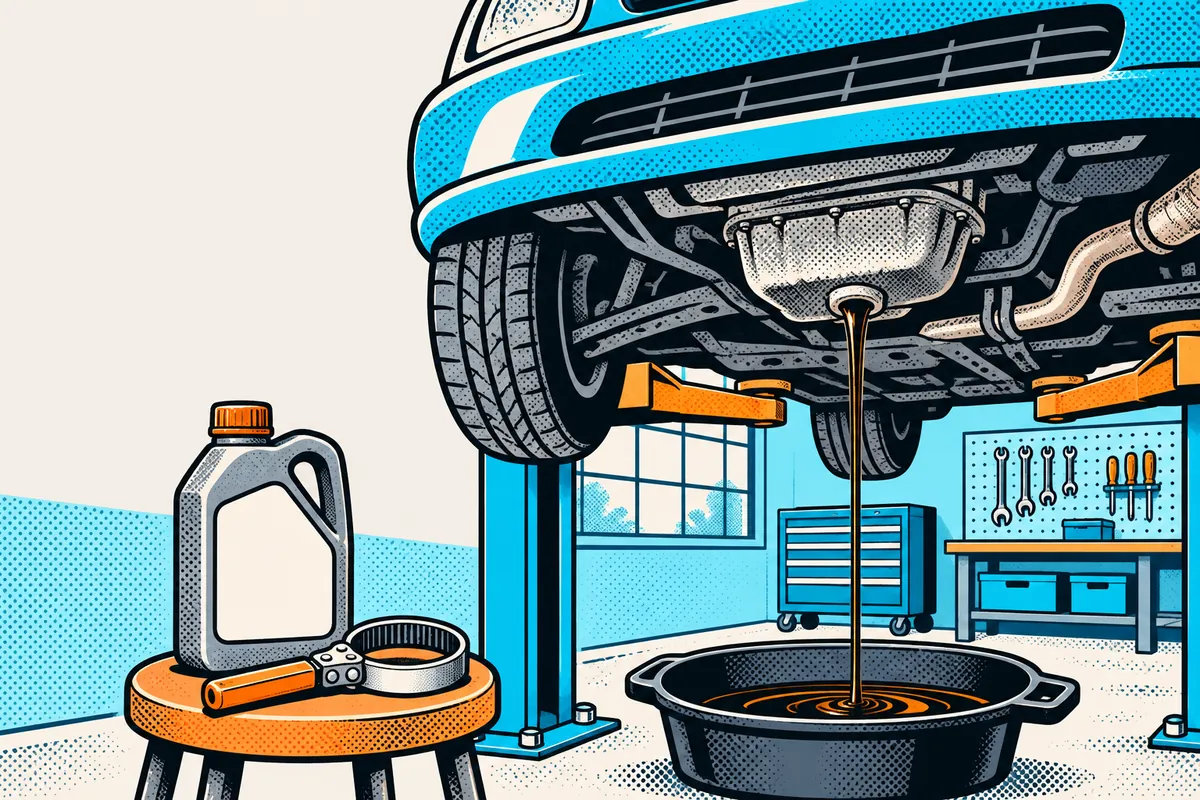
How often to change oil: where your number comes from
Your interval is set by the engine maker, and it is written in three places you can check:
- The owner's manual or maintenance booklet. Look for the maintenance schedule table. It gives an interval in miles (or kilometres) and a time limit in months.
- The oil-life monitor, if the car has one. It estimates how worn the oil is from engine data, then shows a percentage or a service message on the dash.
- The service sticker or the last invoice. A shop usually writes the next due mileage on a windscreen sticker. That figure is the shop's suggestion, so compare it with the manual.
When the three disagree, the manual wins. While a new car is under warranty, following the manufacturer's schedule and keeping proof of each service also protects you if an engine fault is ever disputed.

MechLog records each oil and filter change with date, mileage, cost and shop, and reminds you by date, by mileage, or both, whichever comes first. Get it on Google Play
Mileage or months: whichever comes first
Oil ages even when the car sits. Moisture and fuel from short runs collect in it, and additives break down over time. That is why the manual pairs the mileage with a time limit, and the oil is due at whichever you reach first.
| Your driving | Which limit you usually hit first |
|---|---|
| Long daily commute, high annual mileage | The mileage limit |
| Short trips, weekend car, under a few thousand miles a year | The time limit |
| Car stored for the winter | The time limit, even with very few miles |
| Mix of both | Either one, so track both |
A low-mileage car is the one people forget. If you drive 3,000 miles a year and only watch the mileage, the oil can go well past the manual's time limit.
Normal vs severe service
Many manuals print two schedules. The severe one has shorter intervals and applies when your driving matches its description. Typical conditions listed include:
- Frequent trips of only a few miles, where the engine never fully warms up
- Long periods of idling or stop-and-go city traffic
- Towing a trailer or carrying heavy loads
- Dusty or unpaved roads
- Very hot or very cold weather for long stretches
Read the exact list in your own manual, because each maker words it differently. A lot of everyday city driving meets at least one condition, so check honestly rather than assuming the normal schedule.
Oil change interval for full synthetic and conventional oil
Full synthetic oil resists breakdown better than conventional oil, and engines designed for it often have longer intervals. That does not mean you can stretch any car's interval by switching oil. The interval belongs to the engine, not the bottle.
| Question | Where to look |
|---|---|
| Which oil grade (for example 0W-20 or 5W-30)? | Owner's manual, oil filler cap, or under-hood label |
| Is synthetic required? | Owner's manual: some engines require it |
| Which specification or approval? | Owner's manual, listed as an API, ILSAC or maker standard |
| How long between changes? | The maintenance schedule for your engine, not the oil label |
The grade matters for more than protection. The US Department of Energy's fuel economy maintenance tips note that using the manufacturer's recommended grade can help fuel economy compared with a heavier grade the engine was not designed for.
How often to change the oil filter
Shops commonly replace the filter at every oil change, and many manuals call for it. Some older schedules allowed a filter change at every second oil change. Check your schedule: if it lists the filter at each service, change both together. A fresh filter costs little next to the oil, and old oil left in a used filter goes straight back into the new oil.
Motorcycles, generators and lawn mowers
Small engines follow the same idea with different numbers:
- Motorcycles often list shorter intervals than cars, and many share oil between the engine, gearbox and clutch. Use the oil type the manual names; some car oils are not suited to wet clutches.
- Generators, lawn mowers and outboards usually count in engine hours, not miles, and often ask for an early first change on a new engine.
- Seasonal machines need the time limit as much as the hours, because they sit for months.
Signs to get the oil looked at sooner
The interval is a maximum, not a promise that nothing changes in between. Have the oil and engine checked before the due date if you notice any of these:
- The oil pressure warning light comes on. Stop safely and check the level before driving on.
- The level on the dipstick drops noticeably between checks.
- The oil looks milky or foamy, or smells of fuel.
- New engine noises such as ticking or knocking.
- Oil spots under the car where you park.
Colour alone is a poor guide. Fresh oil darkens quickly in many engines because it carries dirt away, which is its job.
Keep track so you do not have to remember
Three facts settle when the next change is due: the date of the last change, the odometer reading at that change, and your interval in both miles and months. Write them down every time.
- Note the date, odometer, oil grade, quantity and whether the filter was changed.
- Add your interval to both the date and the odometer to get two due points.
- Set a reminder for each, and act on whichever arrives first.
- Keep the receipt. It shows the oil used and proves the service was done.
Between changes, check the dipstick once a month with the car on level ground. Topping up between changes is normal for some engines; a sudden drop or milky oil is something to show a mechanic. For a full list of the other services that come up, see the car maintenance schedule by mileage.
Know when the next oil change is due
Log your last oil change in MechLog and set a date and mileage reminder from your manual's interval. The next service shows at the top when you open the app.
Get it on Google PlayiPhone version coming soon
More guides
- Car Maintenance Schedule by Mileage and TimeBuild a car maintenance schedule by mileage and time from your owner's manual: monthly checks, regular services, the 30-60-90 milestones and age-based items.
- Car Maintenance Log: What to Record and a TemplateA car maintenance log template with the columns that matter: date, mileage, work done, parts, shop, cost and receipt. What to record and how it helps at resale.
- How to Calculate MPG With the Full-Tank MethodHow to calculate MPG: miles driven between two full fill-ups divided by gallons added. Worked examples, partial fills, US vs UK gallons, L/100km and cost per mile.
- Cost of Owning a Car per Year: How to Work Out YoursWork out the cost of owning a car per year, per month and per mile: depreciation, insurance, fuel, maintenance, tax, parking and finance, with a worked example.
Published by Zoranta, the developer of MechLog.